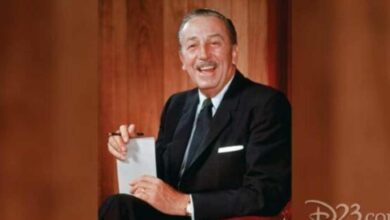
Walt Disney
Walt Disney History Museum
Walt Disney Family Museum Presidio San Francisco scheduled to open in August 2009.
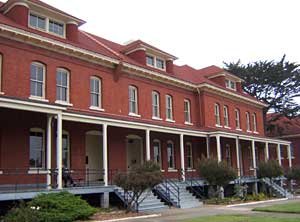
In being adapted for use as the Disney Museum, the brick exterior of this barrack will be seismically strengthened, cleaned, and re-pointed, and its detailing painted. This rehab will scarcely change its appearance.
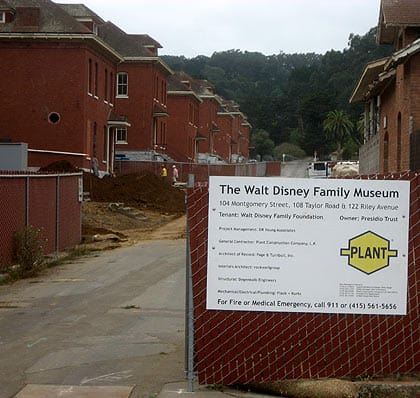
This month, workers are busy converting three historic buildings in San Francisco’s Presidio, a National Park, for the future Walt Disney Family Museum.
“People are very surprised,” says Carolyn Kiernat, principal at Page & Turnbull, the San Francisco firm overseeing the project. “Their first question tends to be ‘Why in the Presidio?'”
Two years ago, Walt Disney’s daughter, Diane Miller, and her husband, Ron, asked Jay Turnbull to design a museum near their home in Northern California about her father’s life and work.
The family found the site ideal, Kiernat says. “Walt Disney was a huge fan of the military and Gen. Pershing [who commanded the Presidio] in particular.” In addition, she says, the museum building “recalls the Main Street USA in Disney World.”
Construction began in May on the 1897 barracks, which, along with a glass-and-steel addition, will serve as the exhibit hall. A 1904 gym will become offices and archives, and a 1940s munitions shed will house the complex’s mechanical systems.
All three buildings, and many others that make up the National Historic Landmark, have been abandoned since 1994. Last year the museum signed a 40-year lease for the federal property.
“We’re working very closely with the [nonprofit] Presidio Trust to make sure we don’t damage or remove any historic fabric,” says Lada Kocherovsky of Page & Turnbull.
Enclosed by a courtyard, the new addition will have views of the Golden Gate Bridge and San Francisco Bay.
“We were trying to take some cues from the historic building as far as height, but really our approach was one of subtle contrast,” Kiernat says.
Source: Nationaltrust.org
Some Highlights from the Collection of the Future Walt Disney Family Museum
The proposed Walt Disney Family Museumat the Presidio will have many priceless objects and artifacts that evoke special moments in Walt’s life and career. Many of these were collected by Walt himself; others are gifts or awards, while some have been acquired by Walt’s family in recent years.

Red Cross Ambulance
One prized possession in the collection is a Ford Red Cross ambulance, similar to the one that Walt drove while working as a Red Cross volunteer in the aftermath of World War I. Using an ambulance just like the one shown here, Walt drove officers and supplies all over northern France.
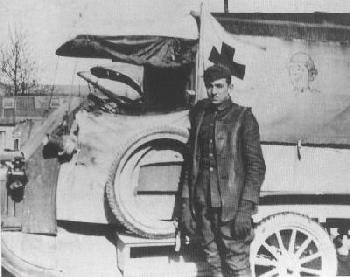
Walt Disney with Original Ambulance
Walt’s Miniatures
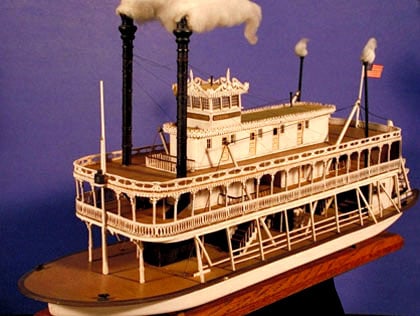
Walt was always fascinated by miniatures, and collected them from all over the world. At one point, Walt even planned to have a miniature traveling exhibit that would have been called “Disneylandia.” This table set is an example of Walt’s extensive private collection. The Museum exhibit will also include this exquisite model of the Mark Twain, a Mississippi paddle boat custom built for
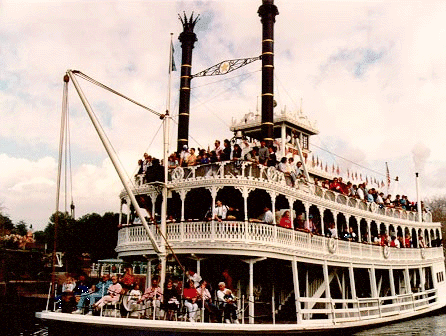 Mark Twain Disneyland, USA.
 Animator’s Desk
Animator’s work desk from the Burbank Studio, specially designed by the industrial designer Kem Weber under Walt’s personal supervisionas was every detail of the new Studio. The desk was specifically designed for the task of animation, with such handy features as a backlit glass platen on which the animator could place his drawings as he worked.
The Red Car
The sleek red sports car was one of 40 Autopia vehicles introduced at Disneyland on Opening Day. It later traveled the country in promotional shows for Disneyland. It was then modified for use by Walt’s grandchildren, who called it “the red car” after it received the addition of a reverse gear, custom hubcaps, and red paint with silver accents.

The Lilly Belle
Another prized possession is the Lilly Belle, Walt’s miniature train which was designed for his new home on Carolwood Drive in Holmby Hills. The train track ran all around Walt’s house. Walt called it the Carolwood Pacific. At the very end of the train is a yellow caboose. It was built by Walt himself in the red barn on the property that served as his workshop.
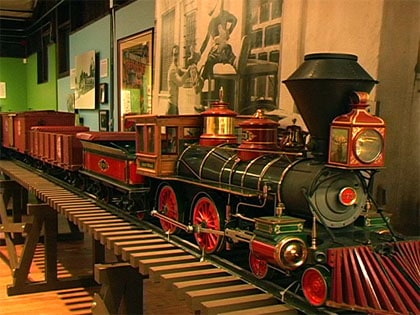

Lilly Belle Disneyland
The ‘Snow White’ Academy Award
The future museum will also include many of the hundreds of awards that Walt received during his lifetime from organizations throughout the United States and around the world. One famous award is the special Academy Award which Walt received for his first feature-length animated film, “Snow White and the Seven Dwarfs.” The award was presented to him by none other than Shirley Temple.
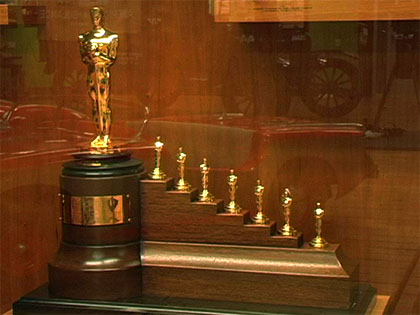

Walt Disney, Shirley Temple 1937
Congressional Medal
In 1969, the U.S. Congress authorized the creation of a special Commemorative Medal which was presented by President Richard Nixon to Lillian Disney some three years after Walt’s death.
Be sure to revisit this website and see our new monthly feature “News About The Museum” to find out more about the proposed Walt Disney Family Museum at the Presidio and its collection ‘

The Origins of the Walt Disney
Family Museum
by Paula Sigman Lowery
The following article, which gives great insights into the origins of a bricks-and-mortar Walt Disney Family Museum in the Presidio, was excerpted from the recently released
Disney Insider Yearbook 2005.
The original idea of the museum, which is a project of The Walt Disney Family Foundation, was a little family office where Walt’s awards, memorabilia and memories would be showcased. Walter Elias Disney Miller, President of the Foundation and grandson of the man for whom he was named, envisioned it as a place “where we would conduct our Walt Disney Family Foundation business while surrounded by an atmosphere that was all about Walt and Lilly, family and career.”
They thought of having small groups of schoolchildren visit the office, to learn a little something about the man behind the name. But the family soon realized their idea of an office was impractical, for like another well-known “field of dreams,” if you build it, they will come. How in the world could their little office/museum accommodate all the people for whom Walt Disney is important?
Meanwhile, the public’s interest in Walt Disney continued to increaseas did misconceptions and misunderstandings about his life. Walter explains, “The interest in my grandpa never seems to go away. When I meet people and they learn that Walt Disney was my grandpa, usually a big warm smile comes across their face, and they tell me how much Bambi, Mickey Mouse, or Disneyland meant to them as a child growing up. People remember where they were on Sunday nights; they never forget crying during “Old Yeller” or the thrill of running down Main Street for that first ride of the day at Disneyland.
“However, inevitably difficult or misunderstood questions surface: ‘Is he really frozen?’ ‘Did he draw all of those characters?’ ‘Was he anti-Semitic?’ ” In spite of numerous books and films about the life of Walt Disney, nonsensical and even hurtful rumors continue to abound about his personal life, the way he treated his employees, and about the type of person he really was.”
Walter continues, “My grandpa was an extremely curious man, and with his legacy the public has grown to be curious about him. Who is Walt Disney, and what made him so successful and talented at what he did? Yet there is a whole generation that does not know that he was a man, a very decent man: a man who worked hard all of his life, a man who loved people, and who is much more than a corporate symbol, or a picture on toys and video packaging.”
The family began taking steps to demystify Walt. In 1998 they produced a biographical CD-ROM, followed by a documentary film in 2001 entitled Walt:
The Man Behind the Myth. They also launched the Walt Disney Family Museum, a virtual museum, hosted online by the Walt Disney Company at www.waltdisney.org.
Still, the family felt they could do more. They returned to the thought of a physical museum.
As time went on, the family’s initial dream of a small museum expanded dramatically in scope. Its mission is to present the life and career of Walt Disney in an honest and entertaining manner, with a museum that will fulfill the needs of serious scholars of the man, his work, and his times.
When asked how the family will accomplish this, Walter Miller is quick to answer. “We hope to tell the story of the man during his life, through his own voice, his family, friends, employees, historians, scholars, and those who were close to him. We want to give the public his life story by those who knew him best.” He has specific goals for the project: “I feel personally that I owe him so much, as a grandson who admires his grandpa, but mostly for what he gave to the world in his short life. We hope the useum will give to the visiting public an experience that they will hold onto emotionally . . . something to grasp onto and leave with, learn from, be inspired by, and have a sense of accomplishment and inspiration as they walk out the doors. Or, simply, to understand what he was about and how he went about it.”
The Museum also has begun building a collection of art and artifacts that will be useful in telling Walt’s story. Still, even more important than the images and artifacts are the stories behind them. “The art is beautiful, but it’s more important to get the words,” notes Diane Disney Miller, Walt’s daughter. “The truth is so important to me. Not an exaggeration or a beautification of his life.”
The Museum will present the story of Walt’s life in the context of the world in which he lived. It is also the story of the men and women with whom he worked. And it is the story of the people artists and astronauts, fans and filmmakers, scientists, and even urban planners who were inspired by his life’s work, and continue to carry on his legacy today.
Assisting the Family Foundation is a cadre of noted historians and filmmakers, teachers and scholars. Walter says, “As my grandpa did time and again, he handpicked the team and made it work. I believe now . . . we have the team in place to make this museum the best it can be.”
In searching for a site for their project, the Disney family considered a number of options. Then Diane and husband Ron Miller, who live in San Francisco, heard that its famed Presidio was closing as an Army base and might be leasing some of its historic buildings in the spirit of civic rehabilitation. The Presidio was once the U.S. Army’s premier West Coast base, serving the nation in that role from 1846 until the 1990s, when it was transferred to the National Park Service as a National Historic Landmark District. Part of the Golden Gate National Recreation Area, it is the world’s largest national park in an urban setting.
When Ron and Diane visited the Presidio, they saw its potential as a home for the museum. San Francisco is an international city with great public transportation, so it would be an easy destination for visitors. But even more important is the idea of preserving a historic structure, putting something wonderful inside, and giving it new life. That aspect is something Diane felt her father would have loved. And they’re helping to develop one of the country’s newest national parks.
Walter agrees: “It truly is one of the most beautiful locations in the world. With the Pacific at our feet and the great city of San Francisco at our door, it is a perfect
fit. I love that you can stroll down to the water’s edge, hike through a eucalyptus forest, visit the Golden Gate Bridge, or picnic on the parade grounds . . . all by foot from our door.”
The Museum will continue the legacy of Walt Disney, sharing not only the truth of his life but also his passion for art, creativity, and innovation. In that spirit, it is hoped that the museum also will become a place for future thinking about the ideas and philosophies that infused his life.
The History of the Presidio

Today, the Presidio in San Francisco is associated with the large military complex that was built between the two world wars. But the site actually has a rich history that goes back more than a thousand years.
It was the home to a native people known as the Ohlone when the Spanish arrived in 1776. The Spanish built missions, houses, and a military garrison, known as a “presidio” in Spanish. At that time, the Presidio was the northernmost settlement of Spanish-held territory in the West, at the end of a long line of Spanish barracks and missions running all along the coast from Mexico.
The purpose of the Spanish presidios was to maintain law and order in the new Spanish settlements and to protect the coast from any British or Russian invasion. The Spanish presence eventually grew to five missions and four pueblos, or towns, in the Bay Area.
In 1821, after the Mexican Revolution, the Presidio was occupied by Mexican soldiers. But the scarcity of local resources prompted one commander, General Vallejo, to abandon the Presidio in favor of another headquarters near Sonoma.
During the war with Mexico, American soldiers landed in 1846 and captured the Bay Area, including the Presidio. Two years later, California was formally transferred by treaty from Mexico to the United States. By then, many immigrants had settled in and around the Presidio, including Russians, Chinese, and Japanese.
The Gold Rush of California greatly boosted the population growth of the San Francisco settlement. The Presidio became an American command center for frequent raids against Indian tribes throughout the Northwest.
After the San Francisco earthquake of 1906, the Presidio set up a huge tent camp for the thousands of refugees made homeless by the destruction in the city.
Though hardly touched by the Civil War, the Presidio was expanded during the First World War. But its heyday was World War II. After the Japanese attack on Pearl Harbor, the Presidio became the headquarters for the Western Defense Command. Its hospital became the largest debarkation hospital in the country for casualties of the Pacific theater.
After the war, the Presidio was the headquarters of the Sixth U.S. Army, housing a complex of some 350 buildings. Only in 1989, near the end of the Cold War, did the Pentagon decide to close the Presidio and transfer the buildings to the National Park Service.
Source: Walt Disney Family
Museum-Disney images property of the Walt Disney Co.