Walt Disney
Walt Disney’s Biography – Part 6 – Mickey Mouse / Children
Mickey Mouse
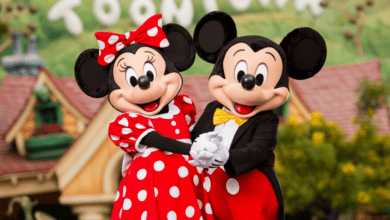
Efforts to sell Mickey Mouse cartoons were initially discouraging. Mickey was just another cartoon creature competing for screen space with Felix the Cat and even Oswald (who continued to be drawn by Mintz’s new staff). The solution: Synchronize one of the three cartoons — “Steamboat Willie” — to sound. Like many of Walt’s ideas, it wasn’t easy. But it was Mickey’s ticket to fame. Walt found a “big and influential guy” named Pat Powers who provided the sound equipment and soon agreed to distribute the cartoons as well. Initial efforts were unsuccessful, but Walt persevered and eventually triumphed. Reviewers — and more important, the public — loved it. Though there were disquieting reasons to think that Powers might not be the most trustworthy of partners, Mickey was soon bringing in enough money for Walt to hire top animators and many trainees. And Walt was ready to use them to begin new enterprises.
[google_ad_atf]“Mickey’s popularity skyrocketed,” writes Charles Solomon, the well-known animation historian, and the loveable mouse soon eclipsed Felix the Cat as the world’s favorite animated character. “A Mickey Mouse cartoon” appeared on theater marquees with the title of the feature, and “What, no Mickey Mouse?” entered the popular lexicon as a synonym for any disappointment. Between 1929 and 1932 more than one million children joined the original Mickey Mouse Club. Mary Pickford, Franklin Delano Roosevelt, Benito Mussolini, the Nizam of Hyderabad, and King George V of England were all Mickey fans. As Mickey’s star blazed ever brighter, he spawned a number of offshoots — Walt and Ub started a newspaper comic strip. Carl Stalling wrote Mickey a theme song, “Minnie’s Yoo Hoo.” (“I’m the guy they call little Mickey Mouse. Got a sweetie down in the chicken house … .”) It, too, became popular from coast to coast.
As the studio cranked out Mickey Mouse cartoons, Walt moved forward on an entirely different front. Up until this time, popular cartoons were based on individual characters and had predictable plot lines. Walt’s new series — to be called Silly Symphonies — would break the mold. They would be animated pieces, generally set to classical music, that would give his animators a chance to experiment endlessly. The first was “The Skeleton Dance.” The cartoon, suggested by songwriter Carl Stalling, featured macabre dancing skulls and bones twirling their way through a graveyard on a moonlit night. Though Pat Powers initially said he couldn’t sell the new cartoon, Walt prevailed, and soon the Silly Symphonies were profitable — and moving the state of animation forward. Walt set up a unit of animators, separate from those who focused on Mickey Mouse, to devote their time to Silly Symphonies.
Though business was booming, checks from Pat Powers were smaller than anticipated and arrived erratically. In late 1929, Roy visited Powers and came to one positive conclusion: “That Powers is a crook. He’s a definite crook.” Walt defended Powers at first. “You don’t believe in people,” he told Roy. Of course Roy was right. Powers had been withholding cash to make the Disney brothers desperate. And finally he announced his intention to take over the Disney studio. His ace in the hole: He had seduced Ub Iwerks — Walt’s star animator — into jumping ship in exchange for a cartoon series of his own. Powers had decided that Ub was really the secret to Walt’s success. Walt was terribly disappointed. But he didn’t consider yielding. And the studio went on without Ub, who gave up a 20% interest in the Disney company that would be worth billions of dollars today.
[google_ad_btf]Meanwhile, Mickey and the Silly Symphonies forged on. Mickey acquired a body of supporting players who became stars in their own right, including Donald Duck, Pluto, and Goofy. When Walt decided it was time to experiment with color, he took a nearly finished cartoon, “Flowers and Trees,” and redid it entirely in beautiful Technicolor. Roy argued that this was expensive and might not work. But Walt won out, and “Flowers and Trees” — in color — won an Academy Award in 1932. Mickey debuted in color in “The Band Concert” in 1935. The studio began using storyboards — wooden boards on which hundreds of sketches could be placed — to make sure that the plot of cartoons flowed. “Three Little Pigs” was a milestone in character development. And “The Old Mill” gave Walt a chance to experiment with techniques for adding depth to cartoons — something that would be required for his next big leap forward.
Children
Walt loved children. Before he had his own, his nieces, Dorothy (brother Herb’s daughter) and Marjorie (sister-in-law Hazel’s daughter) were recipients of his affectionate generosity. “Aunt Lilly made me clothes for my dolls,” said Marjorie. “And Uncle Walt gave me skates and scooters and all the exciting things.” In 1930, Hazel and Marjorie moved in with Walt and Lilly, and Walt acted the father role to the hilt. If Marjorie came home late, Walt would be waiting for her at the top of the stairs when she opened the door. Much to Walt and Lilly’s dismay, their first two pregnancies ended in miscarriages. The third time around, in 1933, Walt wrote to his mother, “Lilly is partial to a baby girl. I, personally, don’t care — just as long as we do not get disappointed again.” They weren’t. On December 18, 1933, Diane Marie Disney was born.
Weeks before Diane was born, Walt wrote, “I’ve made a lot of vows that my kid won’t be spoiled, but I doubt it — it may turn out to be the most spoiled brat in the country.” Walt’s initial tendency was to surround his daughter with toys and games — Christmas of 1934 featured a giant tree and a sea of presents. But true to his vow, he didn’t spoil her. “Dad realized after a time that the more you want things, the better you like them,” Diane said. Walt wanted more children, and when Lilly suffered another miscarriage they decided to adopt. In January 1937, two-week-old Sharon Mae Disney entered the family. The girls had little idea their father was famous. “We weren’t raised with the idea that this was a great man,” said Sharon. “He was Daddy.”
It would have been easy to get newspaper photographers to cluster around little Diane and Sharon sitting on Mickey Mouse’s lap or attending a new cartoon. But Walt and Lilly kept the girls out of the public eye, both for their safety and out of a desire for privacy. This was an incredibly busy time for Walt. He was churning out Mickey Mouse cartoons and Silly Symphonies that garnered a host of Academy Awards. And by the time Sharon entered the family, he had thrown himself thoroughly into work on Snow White, even while thinking about other feature-length animated films that might follow.