Original
Disneyland History
Disneyland Disneyland |
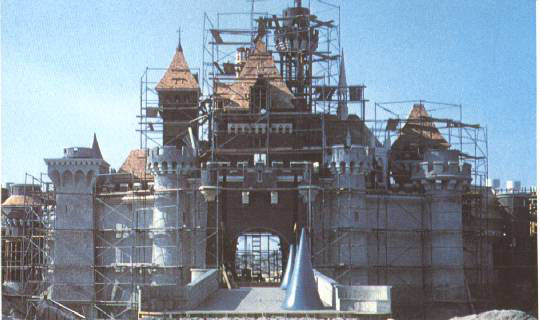
Sleeping Beauty Castle Construction 1955
Matterhorn Construction Pictures 1959
Vintage Disneyland Pictures 1968
Walt Disney talks about the idea for Disneyland
| Click on pictures below to enlarge | |
 |
160 acre orange grove near the Santa Ana Freeway Interstate 5. This is the land Disneyland was built on. |
 |
This is an overhead picture of the construction of Disneyland 1955. |
 |
Walt Disney discussing plans for Disneyland. |
 |
Walt
|
 |
Walt Disney on opening day. Notice Sleeping Beauty Castle Drawbridge actually was in operation that day only. |
 |
Overhead shot of Disneyland complete before Matterhorn |
 |
Overhead shot of Disneyland color with Matterhorn. Here is a bigger picture with more detail |
 |
Walt Disney discussing plans for the Matterhorn. Walt Disney became interested in the Swiss Peak and made a movie about it called “The Third Man on The Mountain.” He then built a very accurate scaled down version in Disneyland. |
Pictures above Walt Disney Productions. 1979
Disneyland Fun Facts:
Location:DISNEYLAND park
“The Happiest Place on Earth,”” is located approximately 27 miles southeast of Los Angeles. Its hometown is Anaheim, California.
Size:
The magic lands and public areas of DISNEYLAND occupy 85 acres of ground. Guest parking for 10,250 vehicles.
Lands:
The magic of DISNEYLAND comes to life in eight “themed” lands:
ADVENTURELAND
Exotic regions of Asia, Africa, India and the South Pacific, featuring the thrilling attraction, Indiana Jones� Adventure.
CRITTER COUNTRY
A down-home, backwoods setting for Splash Mountain and the Country Bear Playhouse.
FANTASYLAND
A happy kingdom of storybook enchantment awaits beyond Sleeping Beauty Castle.
FRONTIERLAND
An exciting realm of pioneers and a return to the Old West.
MAIN STREET, U.S.A.
A composite of small-town America, circa 1900.
NEW ORLEANS SQUARE
The jazzy home of quaint shops, and the classic Pirates of the Caribbean and Haunted Mansion attractions.
TOMORROWLAND
A launching pad for space age attractions into imagination and
beyond.MICKEY’S TOONTOWN
A three-dimensional cartoon world, hometown to Mickey Mouse and his friends.
Hours:
DISNEYLAND is open 365 days a year and offers extended operating hours during holiday periods and summer months.
Attractions:
DISNEYLAND opened July 17, 1955, with 18 major attractions. Today, there are more than 60 attractions.
Area Food & Lodging:
When DISNEYLAND opened, Anaheim had five hotels and two motels with a total of 87 rooms. There were 34 restaurants in the city. Today, Anaheim boasts approximately 150 hotels and motels, with approximately 18,000 rooms and well over 450 restaurants.
Guests:
More than 450 million guests have passed through the gates of DISNEYLAND since Opening Day, July 17, 1955.
Numbers:
The DISNEYLAND” Resort work force includes 21,000 men and women.
Talents:
There are between five and six hundred arts, crafts, professions and skills contributed by DISNEYLAND employees during operation.
Maintenance:
More than 5,000 gallons of paint are used each year to give a better-than-new look. There are almost 20 million gallons of water in the ten bodies of water found in DISNEYLAND. There are more than 100,000 light bulbs used, including 11,000 “rim lights” used to outline the buildings on Main Street, U.S.A. The streets of DISNEYLAND are washed and steam-cleaned after closing each day.
Landscaping:
More than 800 species of plants from over 40 nations are represented in DISNEYLAND. The landscape panorama includes about 5,000 trees and 40,000 shrubs. There are 25 different varieties of grasses, including three acres covered with five different varieties of turf grass. Each year, approximately 1 million annuals are planted. Grounds are watered with more than 50,000 drip emitters and sprinkler heads. It takes a 65-person landscaping staff to maintain the park. The trees range in size from one-foot Dwarf Spruce in Storybook Land to the 75-foot high Eucalyptus trees at the park”s perimeter. The Mickey Mouse flower “portrait” located at the Main Entrance is planted nine times a year.
Custodial:
DISNEYLAND uses 26 million hand towels in its restrooms a year. Additionally, the park uses 1,000 brooms, 500 dust pans and 3,000 mops a year to keep it clean. Approximately 30 tons of trash is collected during a busy park day. Custodial collects 12 million pounds of trash each year.
Recycling:
DISNEYLAND has an extensive recycling program in place. Recycled in one year: 3.1 million pounds of cardboard; 500,000 pounds of office paper; and 9,390 pounds of aluminum cans.
Food:
In one year guests buy: 4 million hamburgers, 1.6 million hot dogs, 3.4 million orders of french fries, 1.5 million servings of popcorn, 3.2 million servings of ice cream, 1.2 million gallons of soft drinks and 2.8 million churros.
Costuming:
Total DISNEYLAND costume inventory is 500,000 pieces. From initial design to public view, a new costume takes from eight to 12 months to produce. The park”s Costume Division stocks approximately 500,000 yards of material, covering 900 different fabrics. DISNEYLAND issues, maintains and cleans costumes for more than 7,000 employees and more than 650 Audio-Animatronics figures. Over 20,000 garments are exchanged per week for cleaning during the summer. Approximately 100,000 individual items are repaired each year. Approximately 150,000 individual pieces are replaced each year, with the average life of an operational costume being nine months.
Calling:
During a 12-month period, the park receives more than 2,000,000 phone calls. The most frequently called person is Mickey Mouse. The most frequently asked questions (apart from those answered by the recorded information line) relate to merchandise and collectibles.
Band:
The DISNEYLAND Marching Band has stepped off nearly 3,500 miles since its first parade down Main Street, U.S.A. on opening day in 1955.
Fireworks:
Unquestionably one of the world”s largest displays of fireworks, DISNEYLAND utilizes the night sky as a stage for “Believe”There”s Magic in the Stars,” the largest fireworks show in the park”s history.
HOW IT ALL BEGAN
“I could never convince the financiers that Disneyland was feasible, because dreams offer too little collateral.”
–Walt Disney
Today, Disneyland, is one of the biggest tourist attractions on the globe. That fact makes it a little difficult to remember that over 45 years ago, Walt Disney was advised by every amusement park operator in the country that the amusement center he envisioned would fall flat on its face. It’s also difficult, after Disneyland”s many years of unbridled success, to recall that following the madhouse opening, most media commentators declared the Park overpriced, badly managed and a likely candidate for a quick and early demise.
Walt Disney, of course, ignored the bad press the same way he ignored all self-appointed experts. The idea of an amusement park unlike any other had been in the back of his mind for at least 20 years before it was actually born.
“It started,” Walt said later, “with my taking my two kids around to the zoos and parks. While they were on the merry-go-round riding 40 times or something, I’d be sitting there trying to figure out what you could do that would be more imaginative. Then when I built the new studio in Burbank, I got the idea for a three-dimensional thing that people could actually come and visit. I felt that there should be something built where the parents and the children could have fun together.”
Artist-architect John Hench, who worked on Disneyland from its beginning (and on Disney films for 15 years before that) recalls when he first heard about a Disney amusement park: “It was back in the forties. I lived on Riverside Drive in Burbank, quite near the Studio. I remember several Sundays seeing Walt across the street in a weed-filled lot, standing, visualizing, all by himself. I remember one feature was going to be a singing waterfall, just one of several ideas. But the longer Walt thought about the park, the more ideas he got, and suddenly the weed-filled lot wasn’t big enough.”
Walt said “It was something I kept playing around with. I’d bring home plans and work on them over the weekend, then I’d go and get a draftsman to lay it out and plan it for me. He worked on my personal payroll, and I had to reimburse the Studio for him.”
Ken Anderson, longtime Disney art director, remembers being one of those pulled from cartoon features (and the Studio payroll) to work on Disney’s personal project. He recalls that some weeks Walt remembered to pay him, and some weeks he didn’t. But Disney would always make good on his forgetfulness, and he always did it in crisp new bills that he failed to count very accurately. It was always more than Anderson received by check from the Studio.
For all of Walt Disney’s early planning, his business partner and older brother Roy didn’t take it very seriously. To one correspondent in 1951 he wrote: “Walt does a lot of talking about an amusement park, but really, I don’t know how deep his interest really is. I think he’s more interested in ideas that would be good in an amusement park than in actually running one himself.”
“Whenever I’d talk about the idea of the park to Roy,” Walt reminisced, “he’d always suddenly get busy with some figures. I mean, I didn’t dare bring it up. But I kept working on it, and I worked on it with my own money. I borrowed on the insurance I’d been paying on for 30 years, and sold my house in Palm Springs to get Disneyland to a point where I could show people what it would be. My wife complained that if anything happened to me, I would have spent all the family money.”
By late 1953 Disney had stretched his personal resources to the limit. At that point, television, in the form of the American Broadcasting Co., came to the rescue. ABC had been after Disney to produce a weekly show for their struggling network. Disney agreed–in exchange for partial financing of his amusement park. Loans and an investment from the Santa Fe Railroad covered the rest, and with money secured, work began on Disneyland in earnest.
Studio employees were taken out of their old jobs of cartooning and set to work on their boss’ latest endeavor. Architects, engineers and designers were hired. Bill Martin, an art director from Twentieth Century Fox, came in on the early stages of planning and was amazed at Disney’s attention to detail.
“He went over my plans with a fine tooth comb. I’d drawn sidewalks on the blueprints with square corners and Walt said: “Bill, people aren’t soldiers! They don’t turn in at sharp angles! Curve the sidewalks! Make the corners round!” Martin adds, he knew from long experience that it was easy to cheat on a drawing and make it look better than it was. He insisted on models and statues being made.”
Walt’s employees responded to the new challenges, and helped out when troubles arose. For instance, there was difficulty obtaining architects” drawings of turn-of-the-century buildings, so animator-director Ward Kimball contributed rare books of drawings from his own collection.
When technical problems arose to block an effect Disney wanted, he had a serene faith in his staff’s abilities to overcome them.
“I was trying to work out a rainbow-colored waterfall for the Mine Train ride,” says artist-designer Claude Coats. “I thought I had the thing working pretty good when Heinz Haber, a scientific colleague of Werner Von Braun’s who was working at the studio, came in. He looked at my set-up, and said it was impossible to make it work for more than a couple of days. After that, the different color waters would splash and run together and turn to gray. I told Walt what Heinz had said about the rainbow waterfall being impossible to bring off. He just winked at me and said: ‘It’s kind of fun doing the impossible.’ So I started working about twice as hard and figured out a way to make it work.”
Ground for Disneyland was broken in summer 1954, and an impossible deadline of the following July was set. Beyond that time, the money would completely run out. Crews worked double shifts to get finished. Walt visited the site daily, and still found time to oversee the burgeoning television and motion picture production at his studio in Burbank.
“The last few months before Disneyland opened were particularly hectic,” says Ken Anderson. “In the two weeks before opening day, we developed the “Twenty Thousand Leagues Under the Sea” exhibit almost from scratch. I was up all night with two other studio artists just before opening day painting the giant squid.”
“Walt, who was supposed to be at a party with his wife, Lillian, was giving a tour for some VIP”s at the Park, but he was too nervous about everything being ready on time to stay there. He went around from ride to ride and exhibit to exhibit, checking work, and helping out. He even came in where we were painting the squid, put on a mask and did a little painting himself.”
Bill Martin remembers other last minute problems: “The big pirate ship in Fantasyland was only half completed opening day. It was no more than an empty shell and we only had time to paint half of it, the half facing the public. The rest remained bare wood. And two days before opening, Sleeping Beauty Castle sprang a gas leak. There were little blue flames burning all around it, but fortunately, we were able to get it fixed.”
Unfortunately, reporters were present to record opening day. The buildings might have been all painted, but street asphalt was still soft, and only a handful of rest rooms were operational. Rides broke down under the stress of opening day crowds. Tempers flared as people were cordoned off from the special show areas where 22 live television cameras were set up to record festivities. The show went on the air on time, but it showed barely-controlled chaos, with miscued cameras and dead mikes.
After that shaky 1955 start, the public and media’s enthusiasm for “Walt’s new toy” grew steadily year by year, entertaining millions, while becoming one of the premiere tourist attractions of our time.